It is a common experience for new Bible readers to sit in a church service and feel a sudden wave of confusion. In one breath, a speaker might passionately declare, “We must preach the gospel to the ends of the earth!” In the very next breath, they might say, “Please turn in your Bibles to the Gospel of Mark.”
Wait—is the gospel a message you preach, or is it a book you read? If you have ever found yourself asking this question, you are not alone.
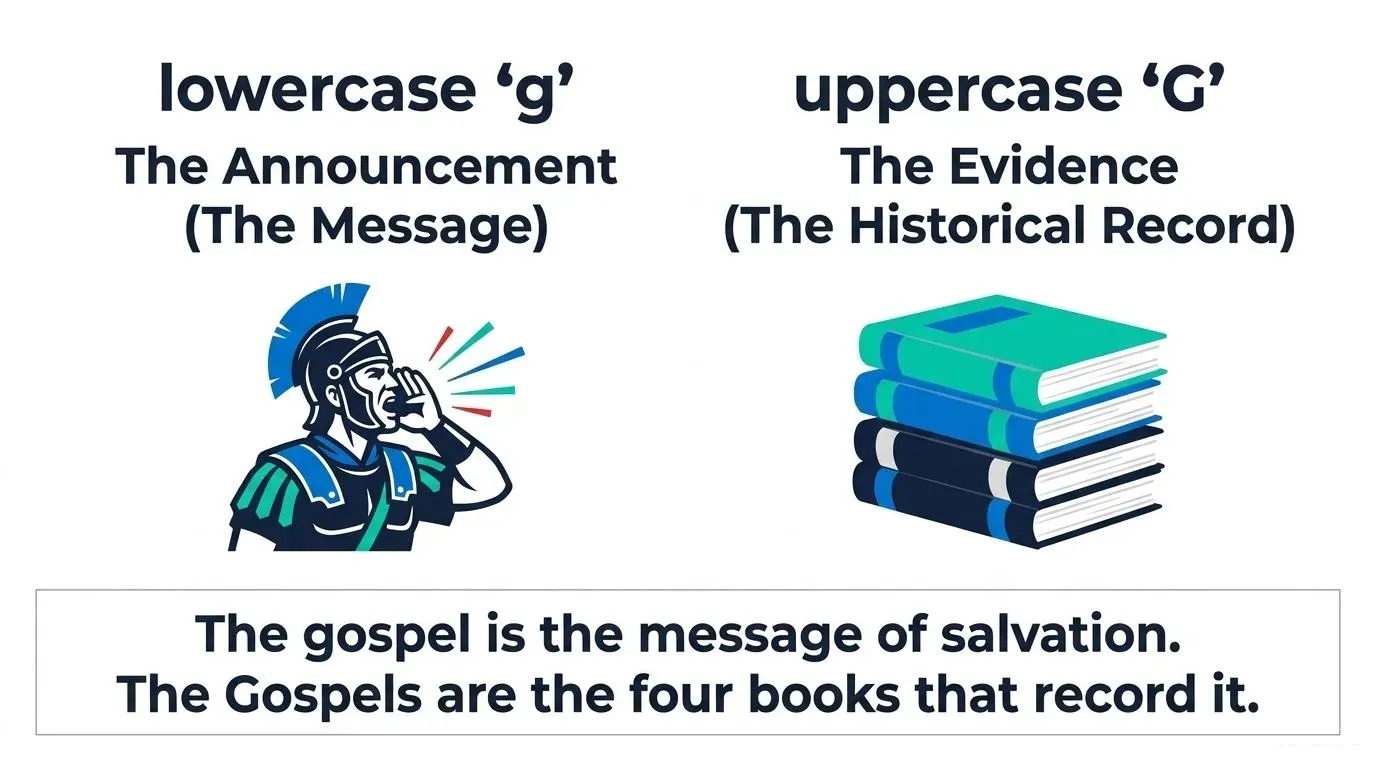
The confusion stems from a simple grammatical and conceptual distinction. The gospel (singular, lowercase) is the world-changing message of salvation, while the Gospels (plural, capitalized) are the four historical books—Matthew, Mark, Luke, and John—that record it. Understanding the difference between gospel and the Gospels clarifies Bible study, strengthens theology, and sharpens evangelism. To make sense of how the New Testament is structured, we can look at it through a simple, memorable framework: the gospel is the announcement, and the Gospels are the evidence.
Quick Answer: The gospel is the message—the good news that Jesus died for sins and rose again (1 Corinthians 15:3–4). The Gospels are the books—Matthew, Mark, Luke, and John—that record the life, death, and resurrection of Jesus. One gospel message; four Gospel books.
What Does “Gospel” Mean? Understanding the Good News
When someone asks, “What does gospel mean?”, they are touching on one of the most important words in the Christian faith. The Greek word behind “gospel” appears more than 75 times in the New Testament—and English translations like the KJV use the word “gospel” nearly 100 times—yet many believers struggle to define it clearly. At its heart, the meaning of the gospel is simple: it is good news—the announcement of what God has done to rescue sinners through Jesus Christ.
Etymology: From Old English to Greek
The English word gospel comes from the Old English godspel, where god means “good” and spel means “news” or “story”. This native translation perfectly captures the active, narrative essence of the original Greek term used throughout the New Testament: euangelion (εὐαγγέλιον), which translates simply to “good news”.
In the ancient Roman world, euangelion was not originally a religious church word; it was a royal, political one. When a new emperor ascended the throne, or when an army won a decisive war, royal heralds—runners sent straight from the battlefront—would carry the euangelion from town to town to announce the victory.
Imagine standing in a busy, dusty Roman marketplace when a runner suddenly bursts through the city gates. He is gasping for breath, but he shouts at the top of his lungs:
“Euangelion! Good news! Our army has won the war, the enemy is defeated, and a new King has taken the throne!”
This is the essence of the gospel (lowercase “g”). It is an urgent, public, and world-changing announcement. The herald does not stop to hand you a biography of the new king or a heavy textbook on military strategy; he simply announces a monumental, completed victory that permanently alters your daily reality.
In one famous example, a Roman inscription from around 9 BC (found at Priene, in modern-day Turkey) used this very word to describe the birthday of Caesar Augustus as “the beginning of good tidings for the world.” Against this imperial backdrop, when early Christians adopted the word euangelion, they were making a bold, counter-cultural, and highly political claim: the true King had arrived, and Jesus, not Caesar, is Lord.
The Gospel as Proclamation, Not Just Information
Modern culture often treats the gospel as a set of religious ideas, helpful advice, or a moral self-improvement plan. But the New Testament presents it differently. The gospel is news before it is advice—an announcement of what God has already done, not a list of things we must do to earn His favor.
The apostle Paul writes in Romans 1:16 (NIV) that the gospel is “the power of God that brings salvation to everyone who believes”. It is not just information to understand; it is power to transform. If the gospel were advice, then its success would depend entirely on our ability to follow it. Because the gospel is news, its power rests on the historical truth of what has already happened: Christ’s death and resurrection for sinners. The true biblical gospel centers on sin, grace, and redemption through Jesus alone, not on messages that promise health, wealth, or personal success.
The Core Gospel Message: What the Bible Says
If you ask a room full of Christians, “What is the gospel?”, you will hear many different answers. Some will mention heaven, others will talk about forgiveness, and still others will reference Jesus’ death and resurrection. But what does the Bible itself identify as the core of the message?
Paul’s Summary in 1 Corinthians 15:3–4
The clearest and most authoritative summary comes from the apostle Paul in 1 Corinthians 15. This passage is often called the gospel in miniature. Paul isn’t offering a suggestion—he’s handing down the gospel message that he himself received and that the entire early church proclaimed. He writes:
“For what I received I passed on to you as of first importance: that Christ died for our sins according to the Scriptures, that he was buried, that he was raised on the third day according to the Scriptures…” — 1 Corinthians 15:3–4 (NIV)
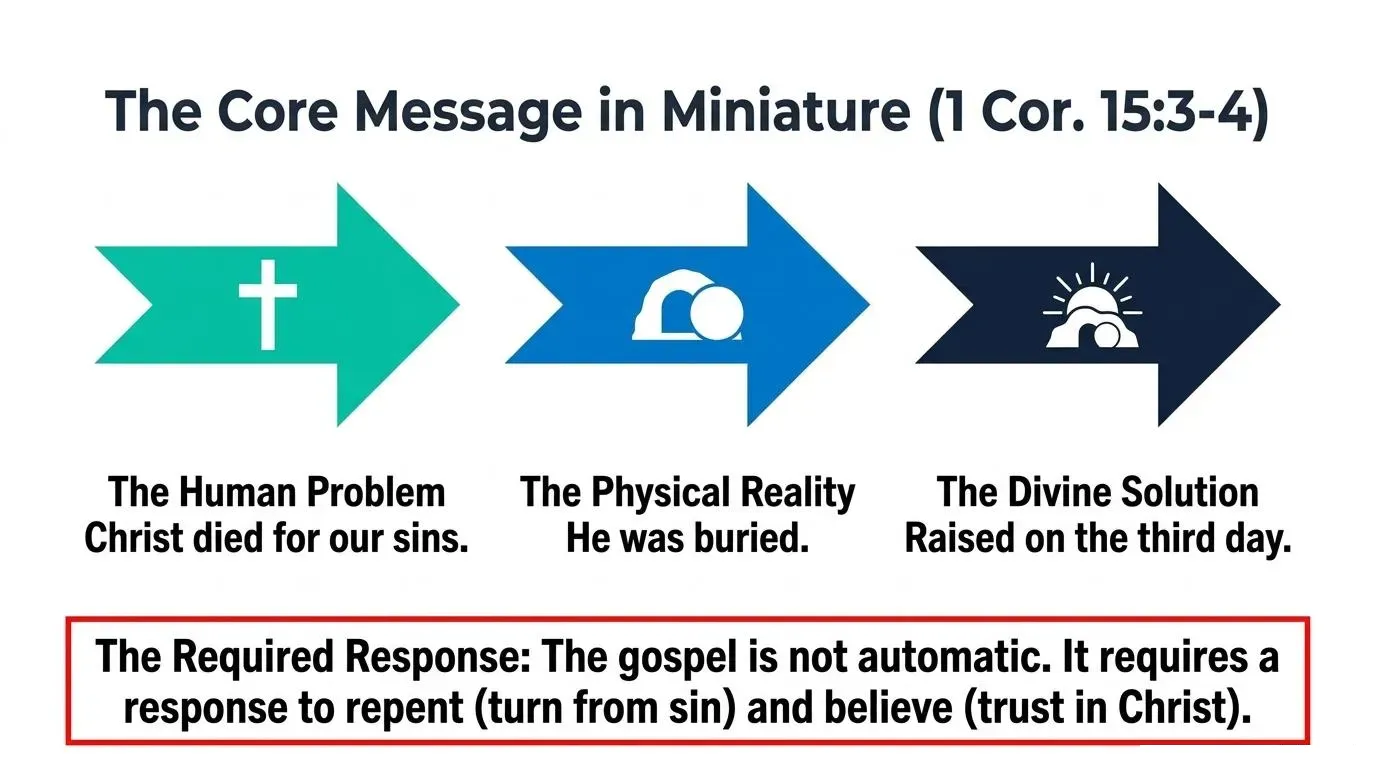
Notice three key elements highlighted in this core kerygma (proclamation):
- Christ died for our sins – Jesus’ death was not an accident or a tragedy; it was a substitutionary sacrifice for sinners. He took the penalty we deserved.
- He was buried – This confirms the physical reality of His death. Jesus did not merely faint; He truly died and was placed in a tomb.
- He was raised on the third day – God vindicated Jesus by raising Him physically from the dead, defeating sin and death.
Paul adds that all of this happened “in accordance with the Scriptures,” meaning the gospel is the perfect fulfillment of God’s promises throughout the Old Testament.
Essential Elements of the Gospel
When we synthesize the New Testament, the core gospel message consistently includes these three vital dimensions:
- The Human Problem (Sin and Separation): The gospel starts with a sober reality: all have sinned and fall short of God’s glory. Sin is not just making minor mistakes; it is active rebellion against God that leads to spiritual death and eternal separation from Him. Because of this, we are completely unable to fix our relationship with God on our own.
- The Divine Solution (Christ’s Work): God did not leave us in our sin. He sent His Son, Jesus Christ, to live the perfect, sinless life we couldn’t live, die the death we deserved to die, and rise again to give us new life.
- The Required Response (Repentance and Faith): The gospel is not automatic; it must be received. Jesus calls people to repent (turn away from sin) and believe (trust in Him alone for salvation). This is not a one-time intellectual agreement, but a lifelong posture of depending entirely on Christ.
How Did Jesus Preach the Gospel Before the Cross?
This connection helps solve a common Bible puzzle: How did Jesus preach the gospel early in His ministry before He had died or risen?
Early in His ministry, Jesus went around preaching the “gospel of the kingdom”. For hundreds of years, the Jewish people had been waiting for God to send a rescuing King to fix their broken world. When Jesus stepped onto the scene, His good news was the massive announcement that the Kingdom of God had finally arrived—the true King was standing right in front of them!
Jesus was inviting people to turn away from their sins, trust Him, and enter God’s kingdom. But Jesus also knew exactly how that kingdom was going to be won. Throughout the four historical books, He constantly prepared His followers, telling them He must suffer, die, and rise again. Once the resurrection occurred, the “gospel of the kingdom” and the message of His victory on the cross merged into a single, completed story. Today, when we share the gospel, we are inviting people into that very same kingdom, opened forever by what Jesus accomplished on the cross.
What Are “the Gospels”? The Four Books of the New Testament
If the gospel (singular) is the message, then the Gospels (plural) are the books that tell the story of that message. When Christians speak of “the four Gospels,” they’re referring to the first four books of the New Testament: Matthew, Mark, Luke, and John. These are not abstract theological treatises; they are narrative accounts of Jesus’ life, ministry, death, and resurrection.
The Canonical Four
The New Testament Gospels are unusual among ancient religious writings—four separate accounts of the same figure, written within decades of His life. Each Gospel account presents Jesus from a distinct angle, yet all four agree on the essentials: Jesus is the Messiah, He died for sinners, and He rose from the dead. They do not compete with one another, nor do they create different versions of faith. Instead, they provide multiple early, converging witnesses.
Why “Gospel” in the Title?
You will often see these books formally titled “The Gospel According to Matthew,” “The Gospel According to Mark,” and so on. This phrasing is highly intentional. It reminds us that there are not four different gospels—there is only one gospel of Jesus Christ. Rather, each book presents the one good news as told by a particular witness.
Think of it like four journalists covering the same historic event. Each writes a story titled “The News According to…” Their accounts will differ in specific details, emphasis, and target audience, but they are all reporting the exact same core reality. Similarly, the Gospel books are four faithful testimonies to the one gospel message. The gospel is the content (Christ’s death and resurrection), and the Gospels are the containers (the four narratives that preserve it).
Different Audiences, One Jesus
One reason God gave us four Gospels instead of just one long, harmonized book is that each author wrote to a different audience with a specific pastoral purpose, highlighting a unique facet of who Jesus is:
| Gospel | Author, Background & Date | Primary Audience | Portrayal of Jesus | Key Themes & Style |
|---|---|---|---|---|
| Matthew | Jewish tax collector & original apostle. (Written: 70s–80s AD) |
Jewish People | The Promised Messiah & King | Proves Old Testament prophecy fulfillment. Focuses on Jesus’ Jewish roots and kingdom righteousness. |
| Mark | Close companion of the Apostle Peter. (Written: Late 60s AD) |
General Seekers | The Servant in Action | Fast-paced, action-packed narrative. Emphasizes miracles, immediate authority, and the suffering servant. |
| Luke | Medical doctor & companion of Paul. (Written: 70s–80s AD) |
Detail-Oriented Seekers | The Savior of the Lost | Orderly, highly detailed history based on careful investigation, presenting Jesus as the universal Savior for all people. |
| John | Original disciple & close friend of Jesus. (Written: 80s–90s AD) |
Spiritual Seekers | The Son of God | Written differently. Zooms in on Jesus’ divine identity, featuring deep, intimate discourses and seven miraculous signs. |
Art History Corner: Why Do We See Lions and Eagles in Old Churches?
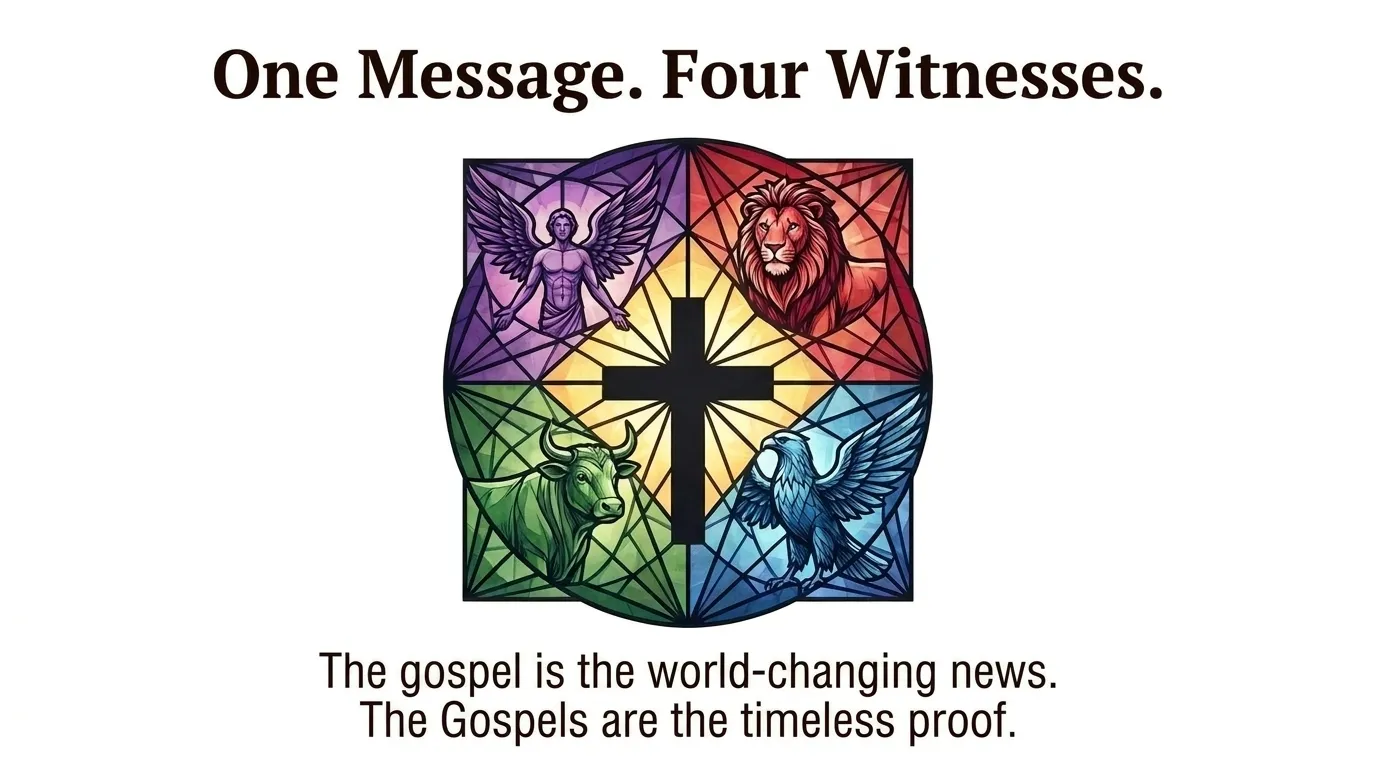
If you have ever walked through an ancient cathedral or looked closely at church stained glass windows, you might have noticed some strange carvings: a winged man, a roaring lion, a heavy ox, and a soaring eagle. Far from being modern fantasy symbols, these are the four living creatures from the biblical books of Ezekiel and Revelation. Early Christian art and theology historically paired each of these symbolic creatures with one of the four Gospel writers to represent their distinct portrait of Jesus:
- Matthew — The Winged Man: Matthew’s account begins by tracing Jesus’s human genealogy, emphasizing His real humanity and His role as the promised King.
- Mark — The Lion: Mark’s narrative starts with a roaring, action-driven opening. It represents the courage, authority, and immediate power of the servant in action.
- Luke — The Ox: Historically, the ox was the ultimate symbol of service and sacrifice. This fits Luke’s servant-hearted focus on Jesus as the Savior who came to give His life to rescue the lost.
- John — The Eagle: The eagle is known for its soaring, heavenly perspective. John’s Gospel similarly takes a “high altitude” perspective, zooming in on deep, eternal truths to highlight Jesus’s divine identity as the Son of God.
This artistic shorthand was a creative way for the early church to visually remind illiterate worshipers of the unique flavor and purpose of each historical biography.
Gospel vs. the Gospels: Key Differences at a Glance
By now you’ve seen that gospel and the Gospels are related but distinct. To make this crystal clear, here is a side-by-side comparison that highlights the technical differences between the message and the books:
| Aspect | Gospel (singular, lowercase) | The Gospels (plural, capitalized) |
|---|---|---|
| What It Is | The good news message of salvation (Greek euangelion) | The four books of the New Testament |
| Focus | What God did in Christ (death, burial, resurrection) | The historical narrative of Jesus’ life, miracles, and teachings |
| Form | Proclamation & Doctrine (kerygma—the message preached) | Biographical-Theological Stories (narrative accounts) |
| Key Texts | 1 Corinthians 15:3–4 (Paul’s gospel summary) | Matthew, Mark, Luke, John (the four books) |
| Common Question | “What is the gospel?” | “What are the Gospels?” |
| Scripture Usage | Used 100+ times to describe the message of salvation | Refers specifically to the four canonical accounts of Jesus’ life |
| Example | “I believe the gospel—that Christ died for my sins.” | “I’m reading through the Gospels this week.” |
Why This Distinction Matters
Confusing these two terms isn’t just a minor grammar issue; it is a theological risk. When we fail to distinguish between the two, we can fall into several common traps:
- Thinking there are four different gospels: There is only one gospel message, told in four complementary ways.
- Reducing the gospel to a mere biography: The gospel is not just a collection of historical facts; it is the active, saving “power of God that brings salvation”.
- Overlooking the purpose of the books: The New Testament Gospels do not exist merely to record dry history; they were written specifically to proclaim the good news and invite readers to believe.
Why Are There Four Gospels Instead of One?
One of the most common questions Bible students ask is, “Why are there four Gospels instead of one?” If the early church wanted to preserve the story of Jesus, why not merge the accounts into a single, streamlined narrative? The answer reveals something profound about how God chose to reveal His Son to the world.
Four Witnesses, One Truth
The early church could have easily combined the four books into one harmonized account. In fact, in the second century, a writer named Tatian tried to do exactly that with a work called the Diatessaron. Yet the early church actively rejected this approach and insisted on keeping all four Gospel accounts separate. Why?
Because four witnesses provide a richer, more credible, and more complete testimony than a single compiled voice. Under both Jewish and Roman legal standards, multiple witnesses were required to establish truth in a court of law (Deuteronomy 19:15; 2 Corinthians 13:1). The four Gospels function like four eyewitnesses in a courtroom, each confirming the core facts while adding unique details that deepen our understanding.
Complementary, Not Contradictory
Critics sometimes point to differences between the Gospels as evidence of contradiction. But careful study shows these are complementary differences, not conflicting ones. Each author selected, arranged, and emphasized material to serve his audience and purpose:
- Matthew includes long sermons (like the Sermon on the Mount) to teach Jewish readers about kingdom righteousness.
- Mark moves quickly from event to event, emphasizing action, immediate authority, and urgency for Roman readers.
- Luke provides detailed historical context and parables about God’s grace for Gentile seekers.
- John includes extended theological discourses and “I am” statements to reveal Jesus’ deity.
These differences do not undermine the historical reliability of the Gospels—they enhance it. Independent witnesses who agree on the essentials but differ in minor details are exactly what historians expect from credible accounts.
The Synoptic Gospels and the Gospel of John
If you’ve ever read through Matthew, Mark, and Luke in succession, you’ve probably noticed something striking: they share a lot of the same stories, often in the same order, sometimes with nearly identical wording. Then you read John, and it feels completely different. This observation has led scholars to use a specific term: the Synoptic Gospels.
What Does “Synoptic” Mean?
The word synoptic comes from two Greek words: syn (together) and opsis (seeing). Literally, it means “seen together”.
Matthew, Mark, and Luke are called the Synoptic Gospels because when you place them side by side, you can “see them together”. They share many of the same events, follow a highly similar geographical structure (Jesus’ ministry in Galilee, journey to Jerusalem, passion week), and contain overlapping teachings. This similarity has given rise to what scholars call the “Synoptic Problem”—the question of how these three Gospels are related and whether they shared common written sources.
How John’s Gospel Is Different
Now open the Gospel of John, and the differences are immediately apparent. While the Synoptics focus heavily on Jesus’ ministry in Galilee, His parables, and His exorcisms, John presents a distinct theological portrait.
- “I am” statements: John records Jesus’ famous statements (“I am the bread of life,” “I am the light of the world,” “I am the resurrection and the life”) which are absent in the Synoptics.
- Extended discourses: John records long theological conversations (e.g., John 3 with Nicodemus, John 4 with the Samaritan woman, John 14–17 with the disciples).
- Different chronology: John records multiple trips to Jerusalem for feasts, whereas the Synoptics focus primarily on His final journey to Jerusalem.
- Fewer parables, more signs: John records seven miraculous “signs” that point to Jesus’ divine identity, but includes almost none of the parables found in the Synoptic Gospels.
- Emphasis on deity: John opens with “In the beginning was the Word, and the Word was with God, and the Word was God” (John 1:1), immediately establishing Jesus’ eternal identity as the Son of God.
John’s Gospel does not contradict the Synoptics; it supplements them. Where Matthew, Mark, and Luke show Jesus in action, John pulls back the curtain to reveal who Jesus is at the deepest theological level. Together, they give us a full, rich, and complete view of the Savior.
Can We Trust the Gospels? A Brief Look at Reliability
In an age of skepticism, many people ask, “Can we trust the Gospels?” Are they reliable historical accounts, or later legends shaped by theological agendas? This question matters because if the Gospel accounts aren’t trustworthy, then the gospel message they proclaim loses its physical foundation. Fortunately, both internal and external evidence support their historical reliability.
Eyewitness Foundations
One of the strongest arguments for trusting the Gospels is that they read like real eyewitness testimony, not later myth or legend. The authors include highly specific, testable details that suggest firsthand knowledge of the culture, geography, and individuals:
- Names of people: They record names of minor, lesser-known individuals, such as Bartimaeus (Mark 10:46), Jairus (Mark 5:22), and Alexander and Rufus (Mark 15:21), who would have still been known in the early church.
- Geographical precision: They demonstrate exact familiarity with local landmarks, describing places like the Pool of Siloam (John 9:7), the Garden of Gethsemane (Matthew 26:36), and the Stone Pavement (John 19:13).
- Cultural details: They naturally capture contemporary social customs, such as washing hands before meals (Mark 7:3), the Samaritan woman’s surprise that a Jewish man spoke to her (John 4:9), and Sabbath laws regarding carrying sleeping mats (John 5:10).
Early Dating and Multiple Sources
Another factor supporting the reliability of the Gospel accounts is their early dating. Scholars debate the exact dates, but a commonly cited range is:
- Mark: Late 60s AD
- Matthew & Luke: 70s–80s AD
- John: 80s–90s AD
This means the Gospels were written within living memory of Jesus’ ministry, while eyewitnesses were still alive to confirm or challenge the accounts. Furthermore, the four Gospels represent multiple independent sources. While Matthew and Luke likely utilized Mark, they also had access to independent traditions (like “Q” and special material unique to each). John is largely independent of the Synoptics. This multiplicity of independent, early sources that agree on the essential events of Christ’s life, death, and resurrection is a powerful argument for their trustworthiness.
Why Only Four Canonical Gospels? The Gnostic Challenge
If you look into ancient history, you will discover that Matthew, Mark, Luke, and John are not the only texts claiming to tell the story of Jesus. There are actually dozens of other ancient writings that use the title of “gospel”—such as the Gospel of Thomas, the Gospel of Judas, the Gospel of Mary, and the Gospel of Philip. Scholars refer to these as apocryphal or Gnostic gospels, and estimates suggest there are anywhere from 20 to 40+ of these texts.
Why, then, does the Christian Bible only recognize four?
The early church accepted Matthew, Mark, Luke, and John as the only canonical (authoritative, inspired) Gospels for two concrete historical reasons:
- They were written far too late: The four canonical Gospels were written by the eyewitness generation or their close associates. In contrast, the Gnostic gospels were written much later—generally in the second century or later—long after the eyewitness generation had died out.
- They contradict the core message: The Gnostic gospels do not just offer extra details; their content actively contradicts the core, original message of salvation found in the four canonical Gospels, sometimes teaching very different and conflicting ideas about who Jesus was.
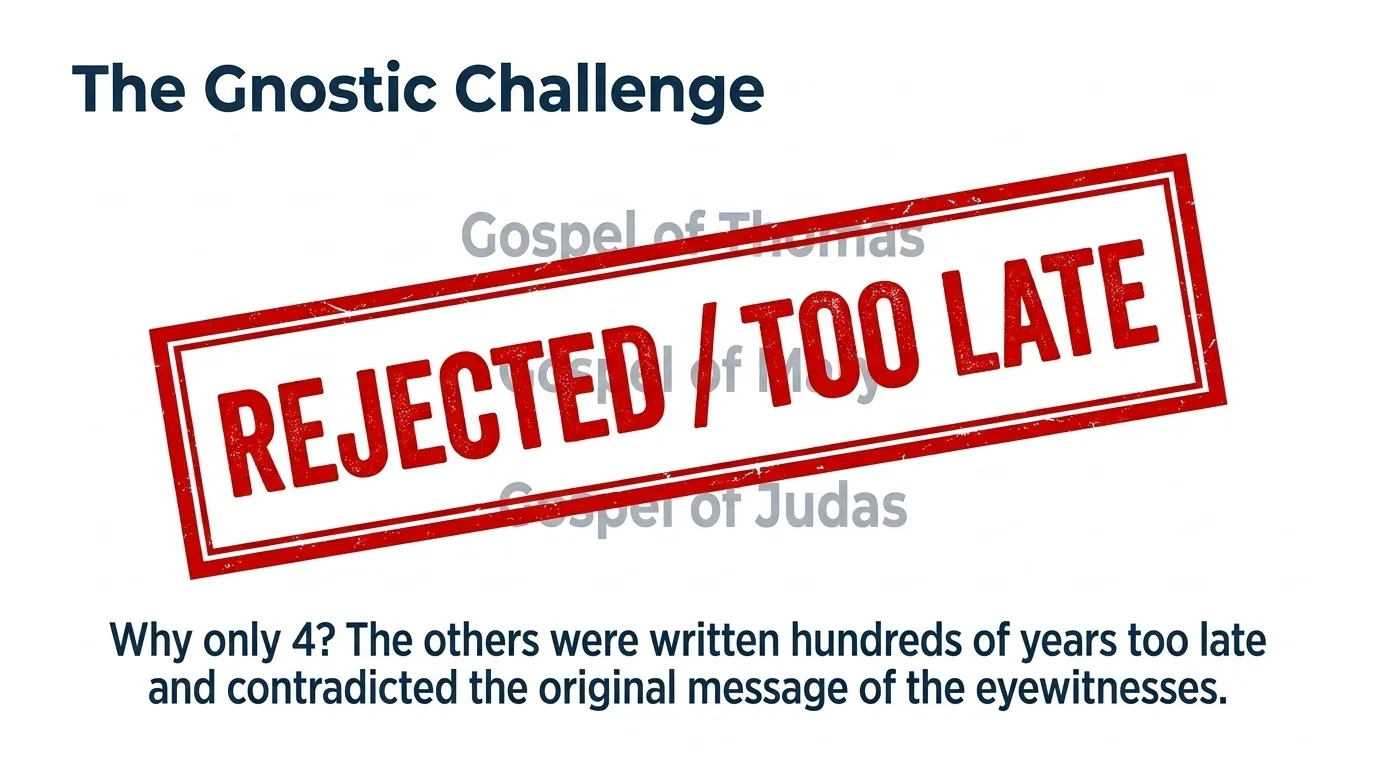
Ultimately, the early church did not accept these books because they failed to meet the rigorous standard of eyewitness truth. The Gnostic texts remain fascinating pieces of ancient history, but they do not carry the historical authority of the original apostolic records.
Frequently Asked Questions
Is the "prosperity gospel" the same as the biblical gospel?
No. One of the most common and damaging confusions today is the "prosperity gospel," which claims that if you have enough faith, God will guarantee you physical health, material wealth, and earthly success. The true biblical gospel centers on sin, grace, and eternal redemption through Jesus alone, rather than formulas for financial success. It is not a message about our performance, but about God's performance on our behalf.
How do I know when to capitalize the word "Gospel"?
Use a Capital "G" (The Books): Capitalize the word when talking about the specific books in the Bible. Example: "I am reading the Gospel of John this week."
Use a Lowercase "g" (The Message): Keep the word lowercase when referring to the good news message of salvation. Example: "Our mission is to share the gospel with others."
What is the difference between the gospel and the Bible?
The Bible is the entire library of 66 books spanning thousands of years of law, history, poetry, and prophecy. The gospel is the singular headline news story that the entire library is building toward, explaining, and applying. This is why you can share the gospel in two minutes without handing someone a physical Bible.
What is the difference between a Gospel and an Epistle?
The Gospels establish the historical foundation of what Jesus did to save us. The Epistles (the ancient word for the letters written by early leaders like Paul and Peter to local congregations) explain how to apply that historical reality to our daily relationships, work, and faith.
"The Gospel According to Matthew" – What Does That Mean?
The phrase literally means: "The good news of Jesus Christ as told by Matthew". Each author presents the one gospel of Jesus Christ from his unique perspective, for his specific audience. There is only one gospel message, but four gospel books.
Which of the four Gospels is the best to read first?
If you are exploring these accounts for the first time, teachers generally recommend starting with one of two books:
- For Clear Meaning (Start with John): If you want to understand why Jesus came and how to have a relationship with God, start with John. It is filled with deep, beautiful conversations about eternal life and God's love.
- For Fast-Paced Action (Start with Mark): As the shortest account, Mark moves rapidly from one miracle to the next, giving a quick, exciting, and easy introduction to what Jesus did.
- For Detailed History (Start with Luke): If you prefer a highly meticulous, chronological history based on careful investigation, Luke is the strongest fit.
- For Jewish Roots (Start with Matthew): If you want to study how Jesus fulfills Old Testament prophecies and serves as the promised King, begin with Matthew.
Put Your Knowledge to the Test
Test What You Just Learned
Review Gospel vs. the Gospels with Flashcards
Reinforce what you just read with 85 flashcards covering the Gospel, the four Gospels, and the key differences between them.
Card 1 of 85 What is the primary distinction between the lowercase "gospel" and "Gospels"? Preview only, click to try the full deckTest Yourself
Take the Gospel vs. the Gospels Quiz
24 questions to check what actually stuck, with a full explanation after every answer.
Question 2 of 24 How does the Gospel of Luke's portrayal of Jesus differ from that of Matthew? Preview only, click below to try the full quiz Start the Quiz